Integrations
AI Assistant supports multiple AI providers. Configure your integrations to enable AI-powered content generation.

Supported Providers






Anthropic
Anthropic is an AI research and product company best known for its Claude family of large language models, which emphasize high-quality and safety-focused reasoning, long context handling, and conversational accuracy for business and creative workflows. Its latest models (like Claude Opus and Sonnet) are tuned for deep reasoning, coding, and complex task support, with robust enterprise APIs and safety guardrails.
Recommended Models
- ⚡
claude-haiku-4.5— fast + cheap- Lightweight tasks
- ⚖️
claude-sonnet-4.6— best- Most use cases
- 🧠
claude-opus-4.6— smartest- Deep reasoning / critical tasks
Google Gemini
Google's Gemini models power a broad suite of AI capabilities across Google products (Search, Workspace, APIs), featuring very large context windows and multimodal understanding (text, images, etc.) for deep reasoning and document analysis. These proprietary models are tightly integrated with Google's ecosystem, making them especially useful for workflows that leverage Search, Gmail, Docs, and other Google services.
Recommended Models
- ⚡
gemini-3-flash— fast + cheap- Most workloads
- ⚖️
gemini-3-pro— more capable- Larger / more complex tasks
- 🧠
gemini-3.1-pro— smartest- Hard reasoning / planning
OpenAI
OpenAI develops the GPT (Generative Pre-trained Transformer) series — including the GPT-5 variants — known for general-purpose language understanding, creativity, and broad ecosystem support (chat, code generation, APIs). These models balance versatility and performance for developers, researchers, and enterprises, with strong tooling and integrations across platforms.
Recommended Models
- ⚡
gpt-5.4-nano— fast + cheap- High-volume, simple tasks
- ⚖️
gpt-5.4-mini— balanced- Balance of speed + intelligence
- 🧠
gpt-5.4— smartest- Complex reasoning, coding, agents
xAI
xAI offers the Grok family of models that aim to provide fast, real-time conversational AI with integrated web search and reasoning; they're available both through the xAI API and consumer interfaces like X and dedicated apps. Grok models (e.g., Grok 4) are positioned on speed, real-time data access, and engaging conversational style, making them stand out from other LLMs by blending dynamic up-to-date inputs with creative responses.
Recommended Models
- ⚡
grok-4.1-fast— fast + cheap- High-volume / low latency apps
- ⚖️
grok-4.1— balanced- General use, improved accuracy/personality
- 🧠
grok-4.20— smartest- Advanced reasoning / agent workflows
Replicate
Replicate is a cloud platform for running and deploying machine learning models, not a single LLM provider. It hosts a broad marketplace of open-source and official AI models (including language, vision, audio, and multimodal models) accessible via simple APIs. Instead of building its own flagship model, Replicate makes it easy to use, fine-tune, share, and scale existing models without managing infrastructure yourself.
Recommended Models
- ⚡
black-forest-labs/flux-schnell— fast + cheap- Prototyping, real-time previews
- ⚖️
black-forest-labs/flux-1.1-pro— balanced- Best mix of quality + speed for most image generation
- 🧠
black-forest-labs/flux-2-pro— best / latest- Highest quality, more advanced image capabilities
SolspaceAI
Built and maintained by Solspace, the team behind Freeform, Calendar and AI Assistant, SolspaceAI is a fully turnkey solution that doesn't use any third-party accounts, API keys, or complex configuration needed. You'll get started instantly with 1,000 free credits, so you can explore it risk-free. When you're ready to scale, simply purchase additional credit bundles to match your usage.
Requirements
- AI Assistant 1.1+ (can be trial, licensed, expired)

Comparison Chart
Which AI service and model should you use? The chart below might offer some assistance with that.
| Provider | Primary Offering | Models / Focus | Strengths / Differences | Typical Use Cases |
|---|---|---|---|---|
| Anthropic | AI research org + LLM services | Claude family (e.g. Claude Opus, Sonnet, Haiku) | Safety-focused, alignment-oriented models with strong reasoning and long-context handling | Complex reasoning, professional writing, customer support, enterprise workflows |
| Google Gemini | Google's flagship AI models | Gemini (3.x series) with multimodal & deep reasoning | Tight integration with Google ecosystem; large context windows and multimodal capabilities | Multimodal tasks, research, speech & vision + language workflows |
| OpenAI | Broad AI platform & APIs | GPT-series (GPT-5 and derivatives) | Very broad ecosystem, deep reasoning & coding support, rich tooling & agents | General purpose chat, creative writing, coding, automation, assistant apps |
| xAI (Grok) | Conversational & real-time AI | Grok family (e.g. Grok-4) | Real-time conversation, social data integration (e.g., X), multi-agent architectures | Real-time insights, social sentiment analysis, fast Q&A |
| Replicate | AI model hosting & deployment | Marketplace of open-source models (images, text, audio etc.) | API-first access to thousands of ready-to-run open-source models — not a single LLM vendor | Hosting, deploying, running/finetuning open-source models in apps |
Setting Up an Integration
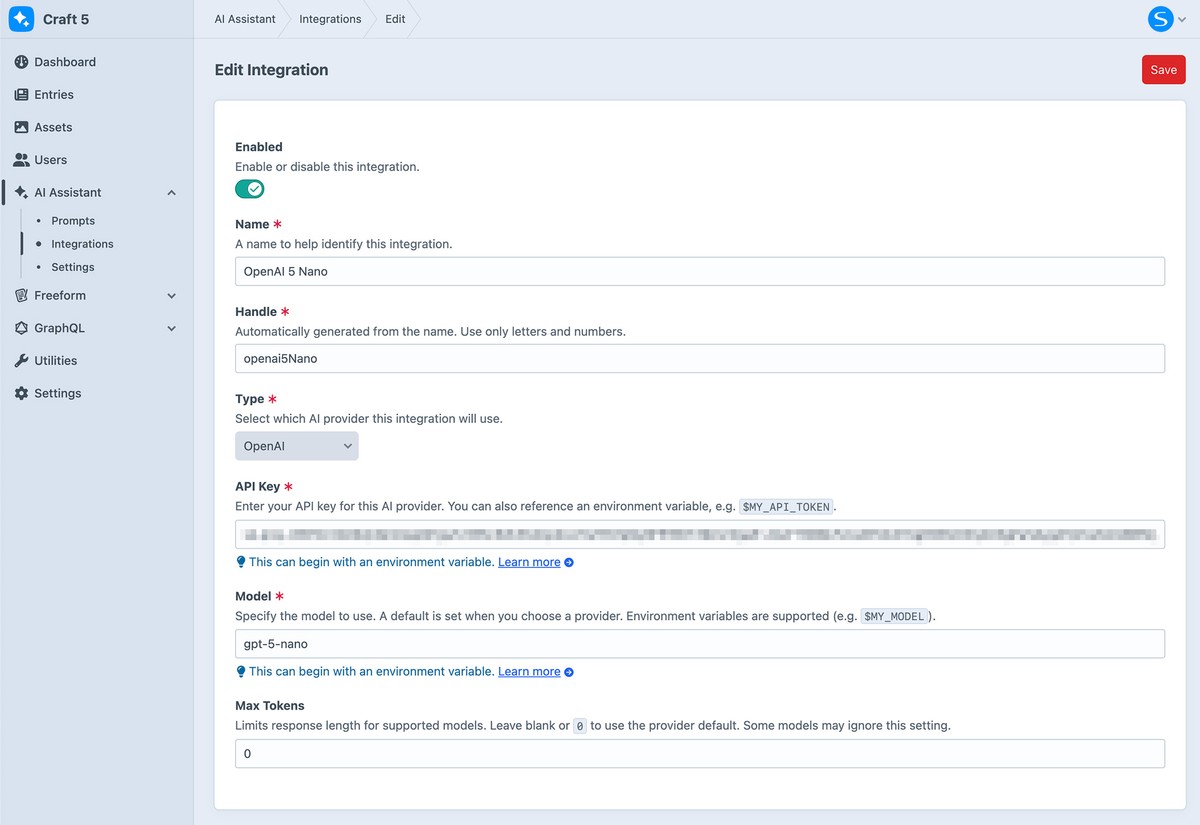
Go to AI Assistant → Integrations and click New Integration
Choose a provider:
- OpenAI (ChatGPT)
- Google Gemini
- Anthropic (Claude)
- xAI (Grok)
- Replicate
Configure the integration:
- Enable/Disable - Toggle the integration on or off
- API Key - Your provider's API key
- Model Selection - Choose which model to use
- Default Settings - Set default parameters for the integration
Save the integration.
Click the Test button on the next page to ensure it's working correctly.
Testing Integrations
After configuring an integration, you can test it using the Quick AI Actions widget or by using the inline AI button on any enabled field.